Houston trades · Plumbing

Plumbing website design and redesign for Houston businesses

The best inquiry gives you enough to call back with a sensible first question. It does not guess at causes, give safety instructions or pretend to book a visit. That restraint is what makes it trustworthy.

The decision

Two kinds of visitor. Two lengths of form.

Asking a person with water on the floor to fill in eight fields is a design failure. Asking a water heater shopper for only a phone number wastes the call. Split them.

Short, phone-first

General issue inquiry

A leak, a slow drain, a toilet that runs. The visitor wants to know if you handle it and how to reach you. The page names the kinds of repair work you take on, shows the phone and hours, and offers a brief message form for when no one can pick up.

Possible fields: Area of the home, short description, location, phone

Considered, a few more details

Planned fixture or water heater work

Replacing a faucet, adding a fixture, changing out a water heater. There is time to read. The page explains the planned work you do, what you usually need to know before visiting, and invites a fuller description.

Possible fields: What is being replaced or added, property type, timing preference, photos only if your form setup supports them

Useful, not presumptuous

What a request can ask, and what it should leave to you.

A good request can collect

  • Where the issue is: kitchen, bathroom, outside, water heater area
  • What they notice, in their own words
  • General location or neighborhood, so you know if it is in your area
  • Best phone number and a good time to call back
  • Whether this is a fix or planned work, such as a fixture or water heater

The website should not

  • Diagnose the problem or name a likely cause
  • Tell the visitor how to shut off water, gas or anything else
  • Promise a time slot, a callback window or a booking
  • Quote a price from the form answers

If you already publish urgent-call guidance, the site can show your exact approved wording. We do not write safety instructions for you.

Illustrative brief

A compact plumbing scope, written out.

An example of how pages could be described in writing for a small plumbing business. It is not a past client and not an automatic allowance. Many plumbing sites need fewer pages than owners expect.

Home
Phone and hours first; two clear routes: something is wrong, or something is planned.
Repairs
Leak, drain and fixture repairs you actually take on, written in homeowner language.
Planned work
Fixture and water heater work you offer, and what a first conversation covers.
Service area
Areas you serve, stated plainly, without separate location pages for places you do not operate.
Contact
Phone, hours, one agreed inquiry form with an issue or planned-work choice.

Price and written scope

Business Website Rebuild, from $4,250 one time.

For a plumbing business, standard work usually means clear service descriptions, a reachable phone line and an agreed basic message form. Online booking, dispatch tools, payment or photo upload systems are not built in; a link to a platform you already use can be agreed.

Standard informational work that fits an approved brief is quoted $4,250. The specific pages, content, layouts, functions, your materials, exclusions, schedule and price are agreed in writing before work starts. More involved or unknown work gets a technical review and its own fixed quote.

Standard work in an approved brief

  • Your approved text, photos and logo, with light refinement
  • Mobile-first layouts and basic on-page SEO
  • An agreed basic inquiry form, plus launch checks
  • One consolidated revision round
  • Source handoff after full payment; 30 days of delivered-defect correction

Not automatic; reviewed separately

  • Automatic CMS or editor, integrations, booking, payment or ordering
  • Customer portals, substantial writing or content migration

Paid by you, in your own accounts

  • Your domain name, purchased and renewed in your own account
  • Website hosting, purchased in your own account (every website needs hosting)
  • Any third-party services you already use, paid directly to their providers

Owner questions

Six questions that shape the form and the pages.

  1. 01What do you need to know on the first call to decide whether a job is yours?
  2. 02Which repairs do you prefer not to take, and should the site say so?
  3. 03What should a visitor do if they cannot reach you, and is that already true today?
  4. 04Who reads web inquiries, and how quickly can they realistically respond?
  5. 05Are your water heater and fixture options things you can describe in writing, or best discussed?
  6. 06Which outside review or scheduling links already exist and must keep working?

If your current site only has a wrong phone number or a broken form, a targeted fix may be enough. Our redesign guide explains repair versus rebuild.

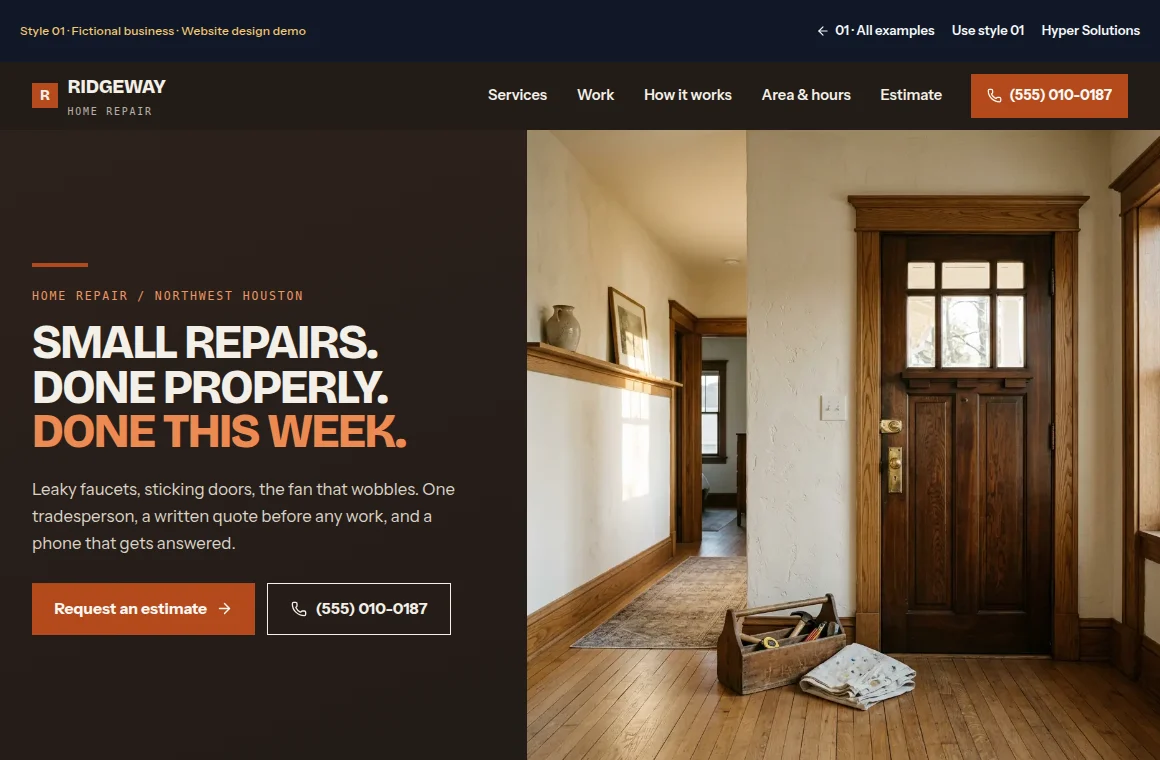
Desktop preview of Ridgeway Home Repair, a fictional general repair website demo
Fictional demo

See the direction in a working fictional demo.

Ridgeway Home Repair is a fictional general repair business, not an actual plumbing client or a trade-specific case study. Use it to explore service presentation and an inquiry path. Its pages and features are not automatically included in your quote.

For a plumbing brief, notice how a short inquiry can sit beside services without crowding the phone number. The issue-versus-planned split would be decided in your own scope.